
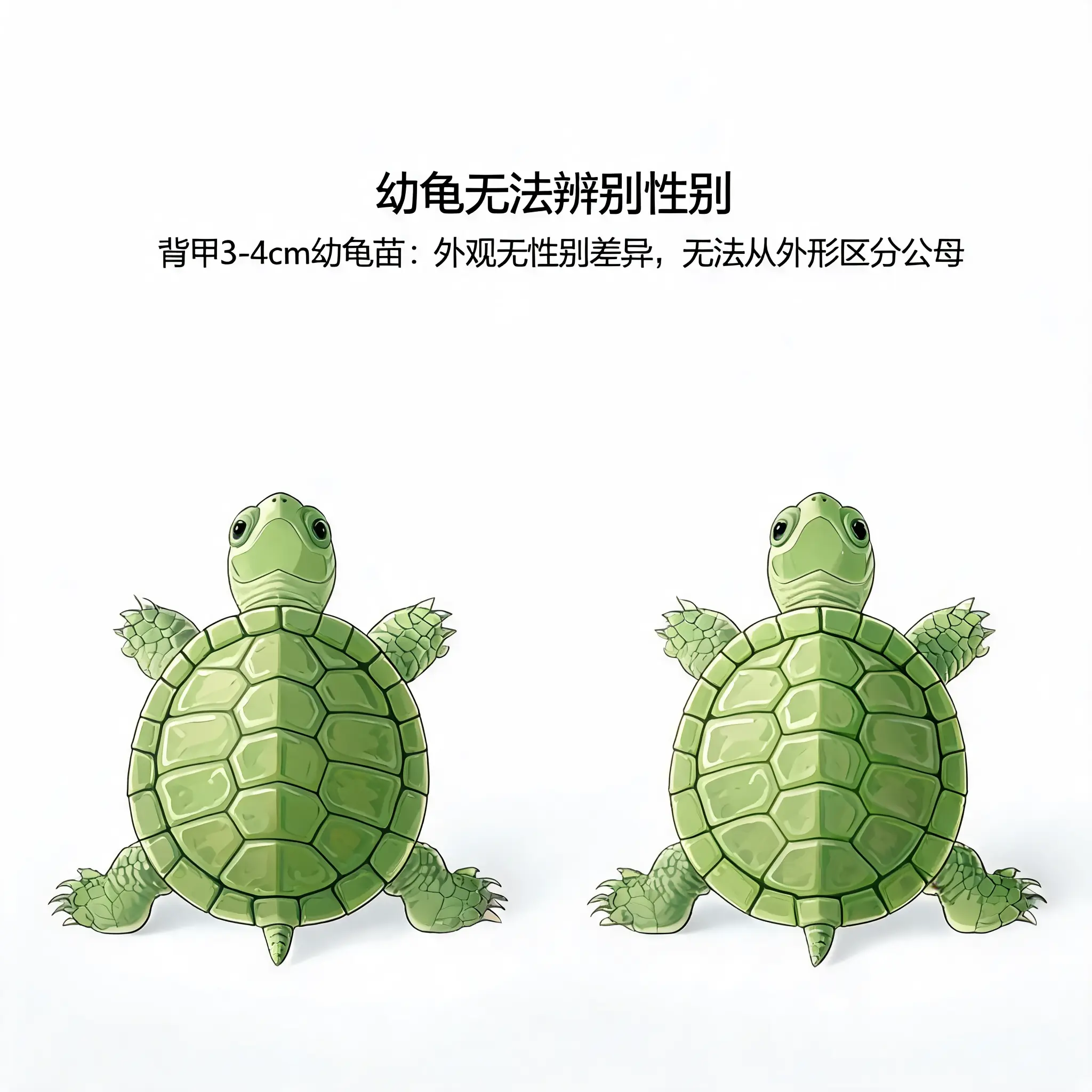
Turtles determine sex differently from most animals. Turtles have temperature-dependent sex determination (TSD): the temperature during incubation determines the embryo's sex, not genetic factors.
This means:
- Lower incubation temperature (about 26-28°C): develops into a male
- Higher incubation temperature (about 30-32°C): develops into a female
- Intermediate temperatures: may produce a mixed ratio
So unless the incubation temperature is known exactly, a hatchling's sex simply cannot be predicted. A hatchling's secondary sex characteristics have not yet developed, and males and females look almost identical—anyone claiming to tell a hatchling's sex is unreliable.
When Can You Start Telling the Gender?
A turtle needs to reach a certain size before its sex can be accurately identified. Generally:
- Chinese pond turtle: carapace length over 8-10 cm
- Red-eared slider: carapace length over 10-12 cm
- Chinese box turtle: carapace length over 12 cm
Judging too early is error-prone. It is best to wait until the turtle reaches adulthood or the sub-adult stage before sexing it.
How the Sex Traits Differ by Species
The sex characteristics differ among species:
- Red-eared slider: males have especially long claws and brighter head stripes
- Chinese pond turtle: males turn black all over (melanism) and have longer, thicker tails
- Chinese box turtle: males have a flatter carapace and a thick, large tail
Only by knowing the traits of the species you keep can you judge the sex more accurately.
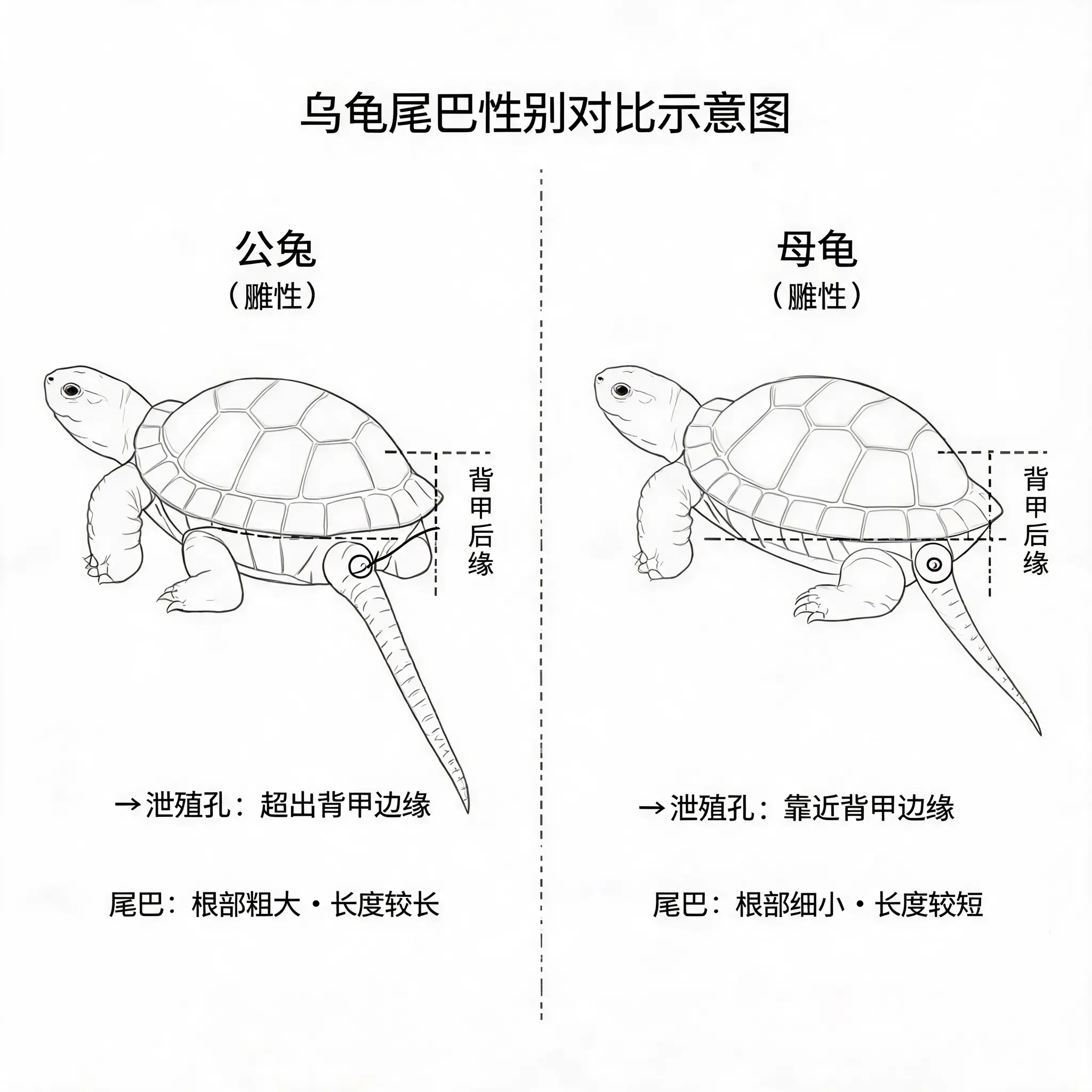
The tail is the most direct and reliable sex-identification feature. Male and female tails differ noticeably.
Male tail traits:
- The tail is longer, extending beyond the hind legs
- The base of the tail is thicker (to house the reproductive organs)
- The vent (cloaca) sits further back, beyond the edge of the carapace
Female tail traits:
- The tail is shorter, not extending beyond or barely reaching the hind legs
- The base of the tail is slender
- The vent is near the carapace edge or slightly inside it
This is the most accurate method, with accuracy above 95%.
How to Observe the Tail Correctly
Tips for observing the tail:
- Let the turtle relax naturally; do not pull the tail by force
- Observe from the side, comparing the tail length with the hind legs
- Observe the vent position from behind
- Check several times to confirm, avoiding misjudgment from the tail retracting when the turtle is nervous
Note: hatchlings all have short tails, so do not use this method to sex a hatchling.
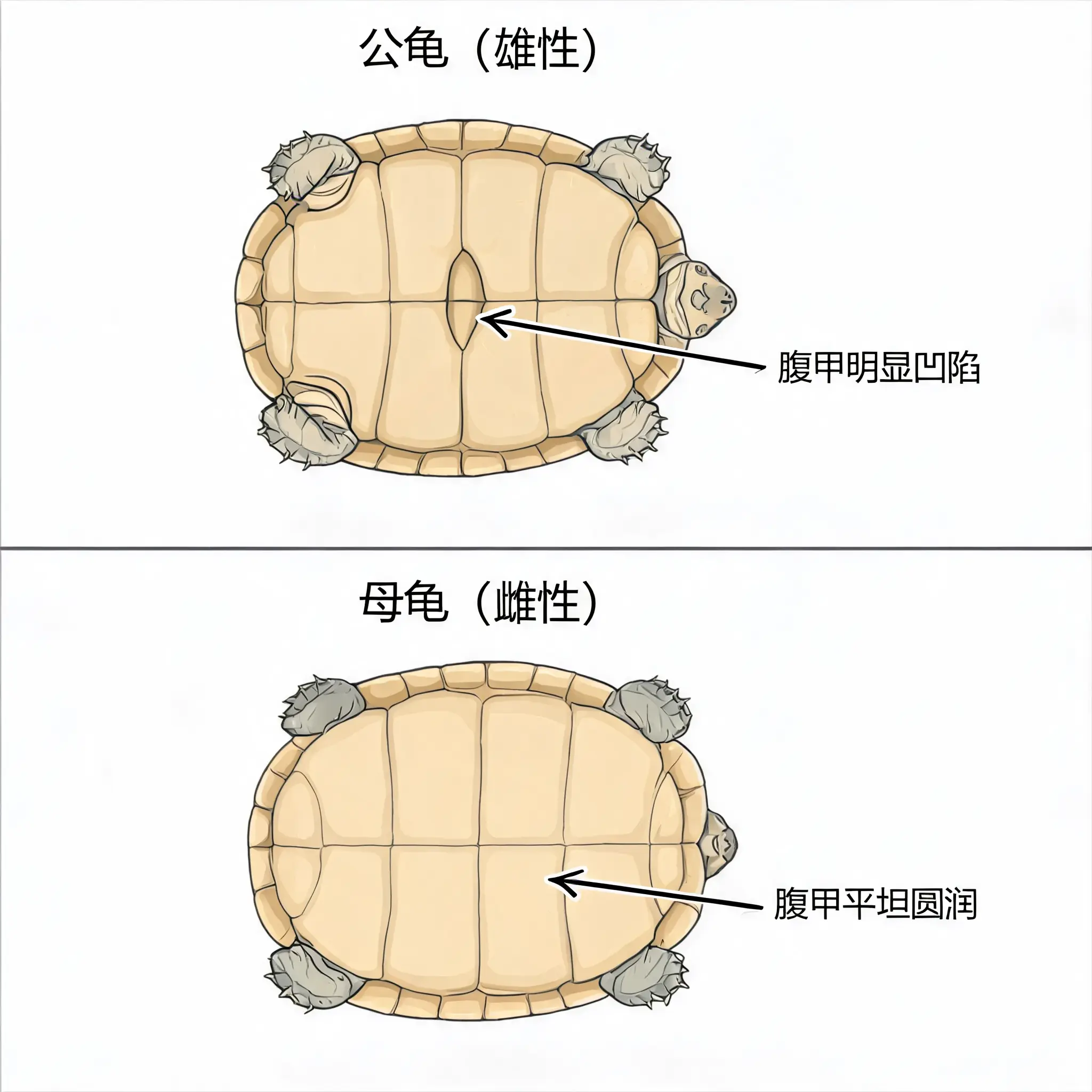
The shape of the plastron (the shell under the belly) is another important feature. Males have a noticeable concavity in the plastron to make mating easier.
Male plastron traits:
- A clear concavity in the center of the plastron (sunken inward)
- The concavity helps it stay steady when mounting the female's shell
- The depth of the concavity increases with age
Female plastron traits:
- The plastron is flat or slightly convex
- It accommodates more egg space
- Overall more rounded
Turning the turtle over to observe the plastron shape can help judge the sex. But this method does not work on hatchlings—the concavity only becomes obvious after adulthood.
Notes on Observing the Plastron
Key points for observing the plastron:
- Gently turn the turtle over and place it on a flat surface
- Feel along the midline of the plastron with your finger to sense the concavity
- Compare with turtles of the same species; the depth of the concavity varies by species
- In some species (such as the Chinese box turtle) the concavity is less obvious than in aquatic turtles
Note: turn the turtle gently to avoid frightening or injuring it. Return it to its normal position immediately after observing.
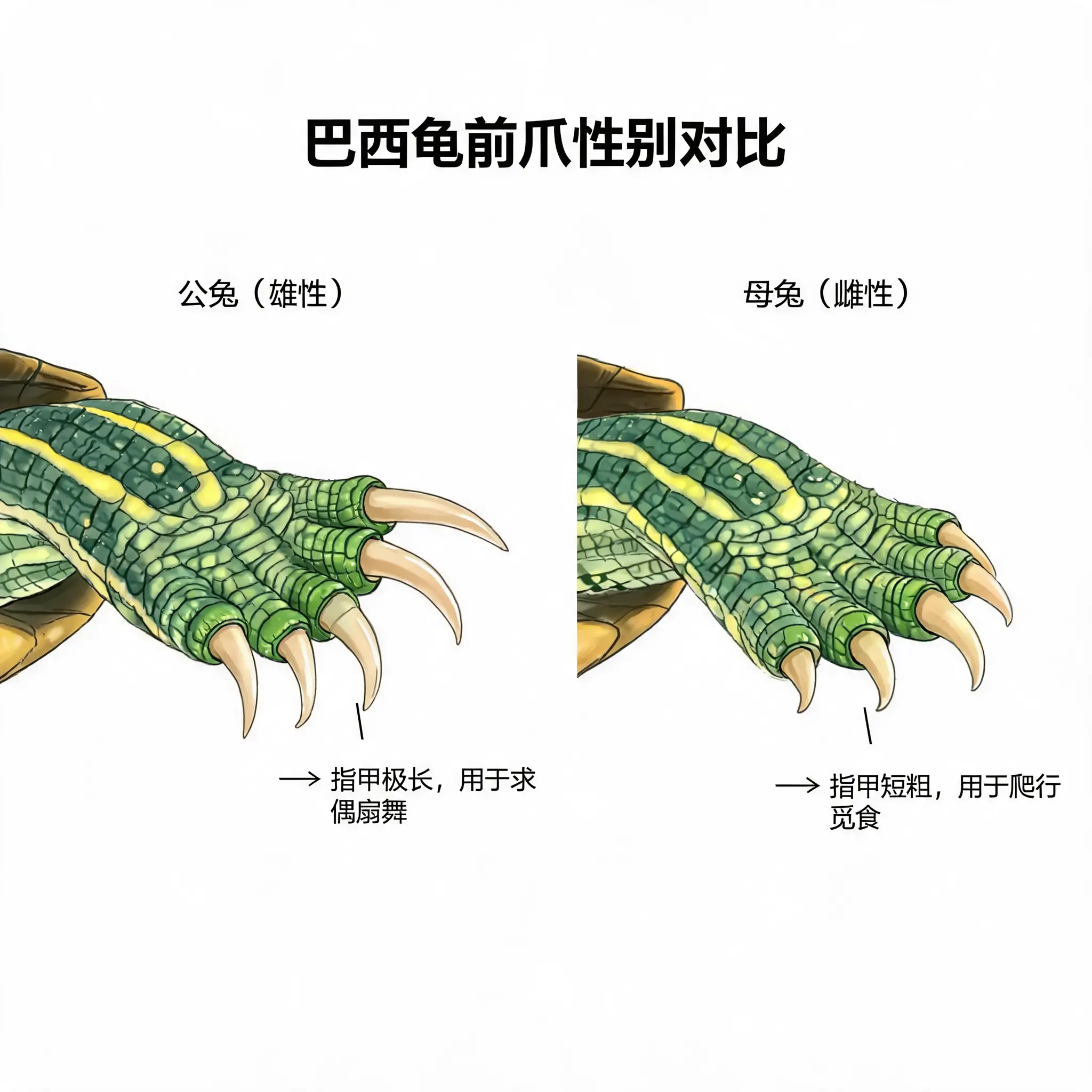
Front claw length is a prominent sex feature in red-eared sliders and some other species. A male's front claws are used to "fan" the female's face during courtship, so they have evolved to be especially long.
Male front claw traits (red-eared slider type):
- The front claws are especially long, clearly out of normal proportion
- Used in the "fan dance" behavior during courtship
- Become obvious after reaching the sub-adult stage
Female front claw traits:
- The front claws are normal in length, short and practical
- Used for normal crawling and gripping
This method mainly applies to red-eared sliders and their variants (albino, golden, caramel, etc.) and works poorly for Chinese pond turtles and other species.
Tips for Judging Claw Length
Key points for judging claw length:
- Compare the front claw length with the length of the toes
- Male claws can reach 1.5-2 times the toe length
- Female claws are about the same as or slightly shorter than the toes
- Wait until the turtle reaches the sub-adult stage (carapace over 10 cm)
Note: do not judge by claws alone; combine the tail and plastron.
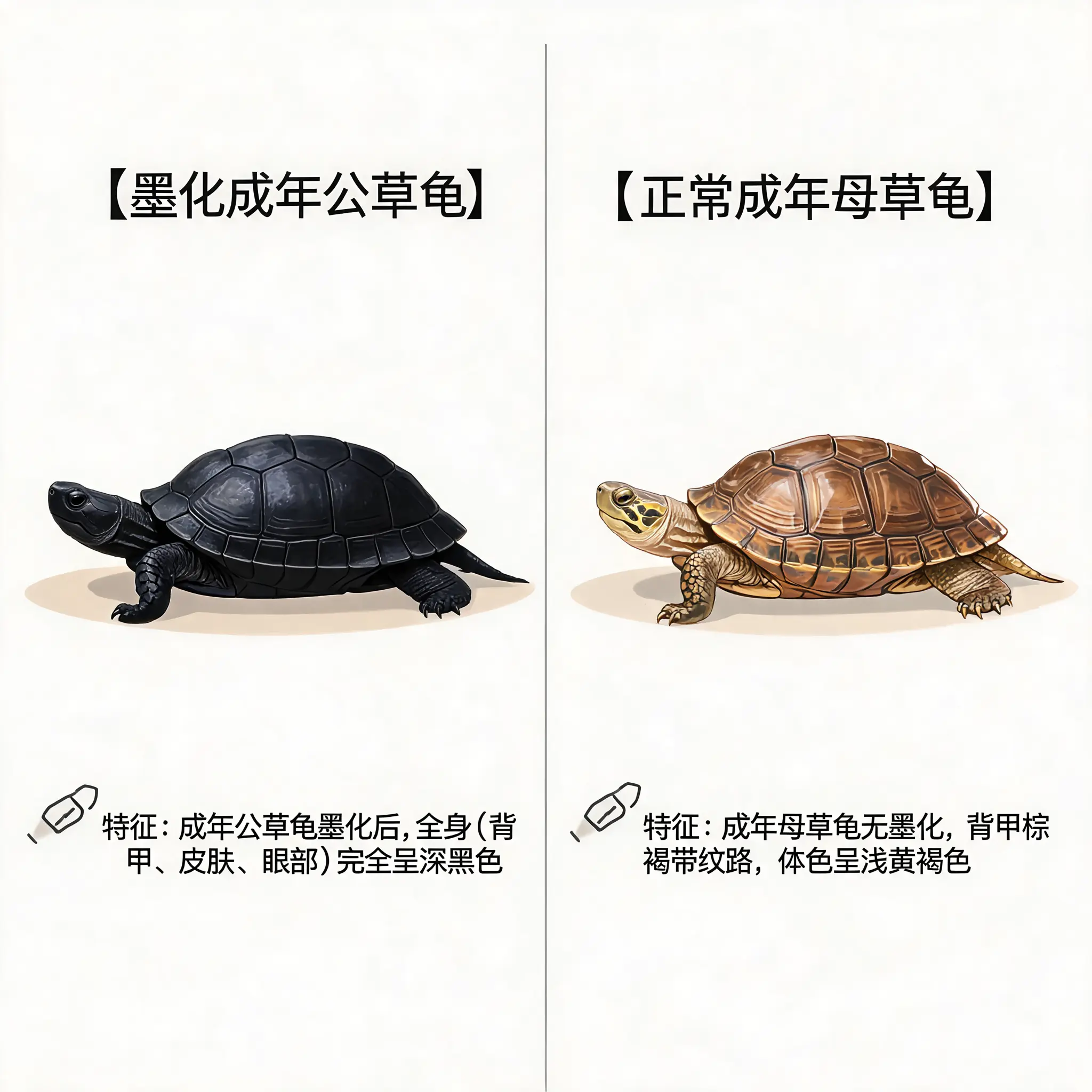
Color change is an important sex feature in some species. The most typical is the "melanism" of the Chinese pond turtle.
Melanism in the Chinese pond turtle:
- Male pond turtles gradually turn black as they mature, called "black turtles"
- The whole body (including shell, skin, and eyes) may turn black
- The degree of melanism varies with the individual and age
- Females keep their normal brown color
Color differences in red-eared sliders:
- Males' head and body stripes are usually brighter and redder
- Females are relatively more subdued in color
- But this feature is influenced by the habitat and individual variation and is not reliable enough
Body color can be a supporting clue, but not the main basis.
About the Degree of Melanism
Notes on melanism in the Chinese pond turtle:
- Melanism is a gradual process, usually completed in 3-5 years
- Not every male pond turtle becomes fully black
- Some males may be only partly black or not black at all
- The environment and nutrition affect the degree of melanism
So: a black turtle is definitely male, but not every male turns black. Do not judge the sex by color alone.
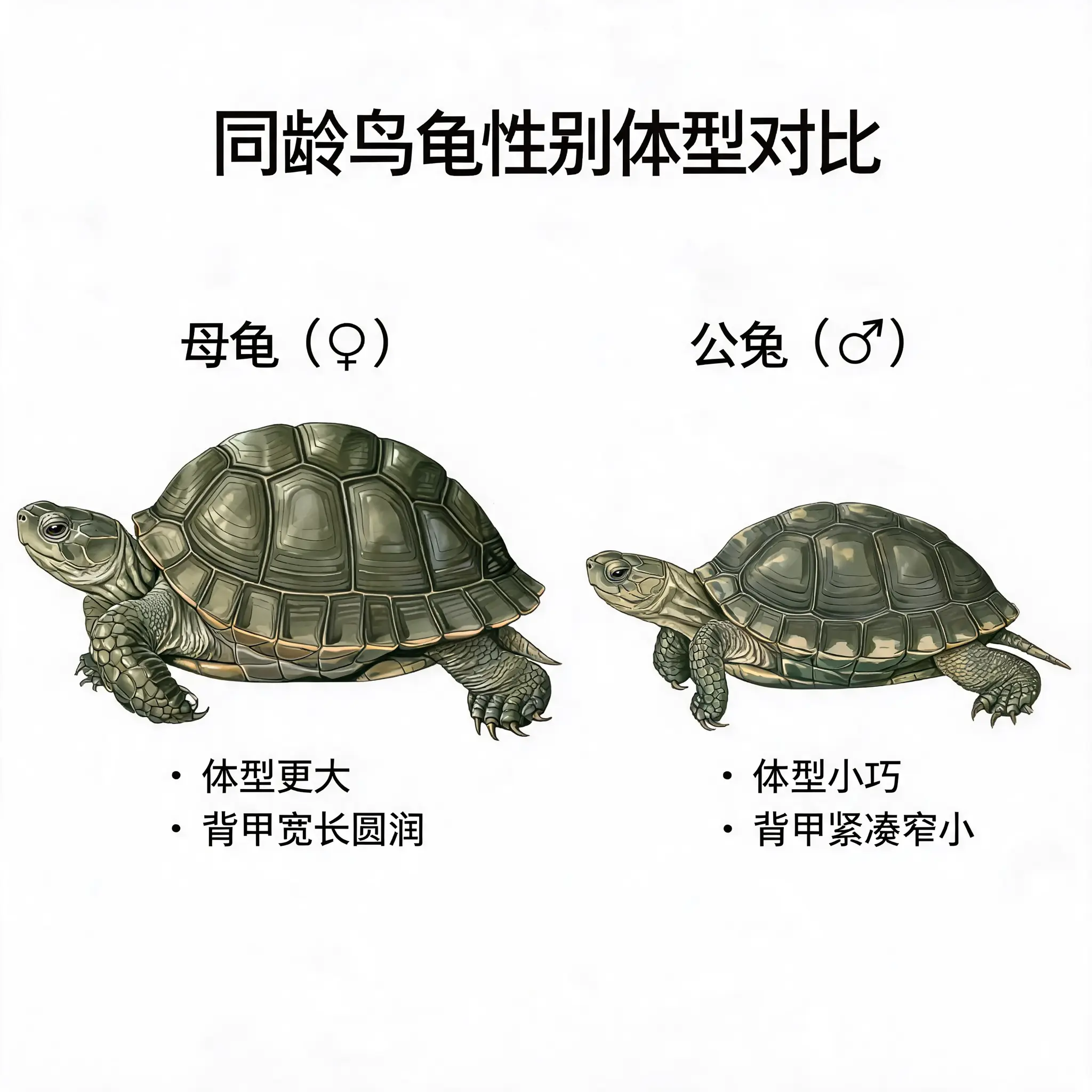
Male and female turtles of the same age differ noticeably in size. Females are usually larger to accommodate eggs.
Size-difference patterns:
- Same age and species: females are larger than males
- Females' carapaces are longer, wider, and more rounded
- Males are relatively small and compact
- The gap becomes obvious after adulthood (up to 20-30%)
But size judgment has limits:
- A comparison turtle of the same age is needed
- Housing conditions affect growth rate
- A turtle kept alone is hard to judge
Size can be a supporting reference, but it must be combined with other features.
When Size Judgment Applies
Scenarios suited to size judgment:
- Keeping several turtles of the same age and species
- Being able to compare the size difference
- Combining it with other features
Scenarios not suited:
- Keeping a single turtle
- Not knowing the turtle's exact age
- Comparing turtles kept under different conditions
Advice: use the size difference only as a reference, not on its own.
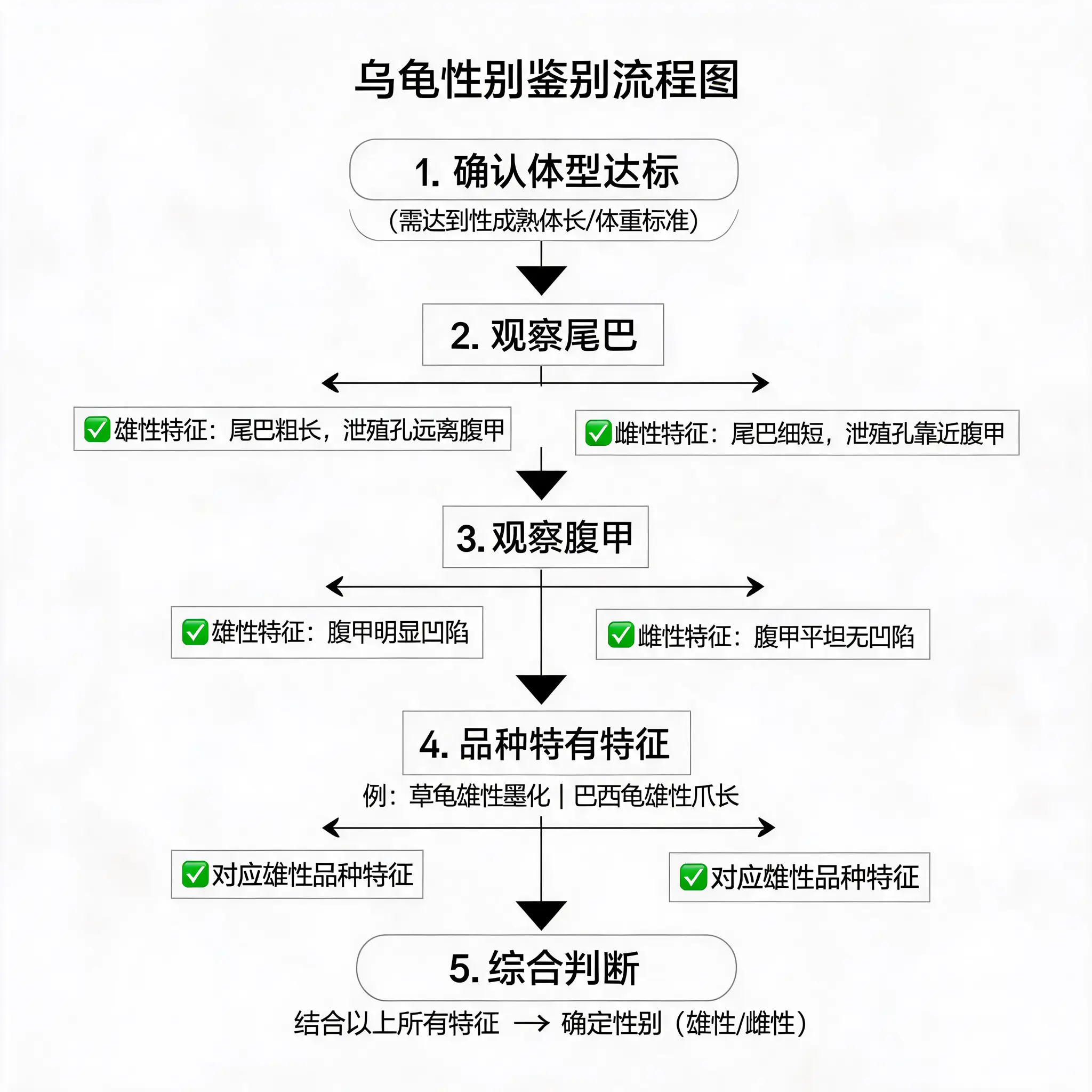
A single feature may lead to a wrong call, so combining multiple features is recommended. Here is the recommended workflow:
Step 1: Confirm the turtle's size qualifies
The carapace must at least reach the species' identification standard (pond turtle over 8 cm, red-eared slider over 10 cm).
Step 2: Observe the tail (most important)
Check the tail length and the vent position; this is the most reliable feature.
Step 3: Observe the plastron
Turn the turtle over and check whether the plastron is concave.
Step 4: Species-specific features
- Red-eared slider: check the front claw length
- Chinese pond turtle: observe the degree of melanism
- Chinese box turtle: check how flat the carapace is
Step 5: Make an overall judgment
If 3 or more features agree, the judgment is reliable; if they disagree, observe repeatedly or consult an expert.
Accuracy Reference
Accuracy reference for each feature:
- Tail feature: over 95% (most reliable)
- Plastron concavity: 85% (adult turtles)
- Front claw length: 80% (red-eared slider type only)
- Body color melanism: 90% (fully blackened pond turtles only)
- Size comparison: 70% (comparison needed)
Combining 3 or more features, the accuracy can reach over 95%.
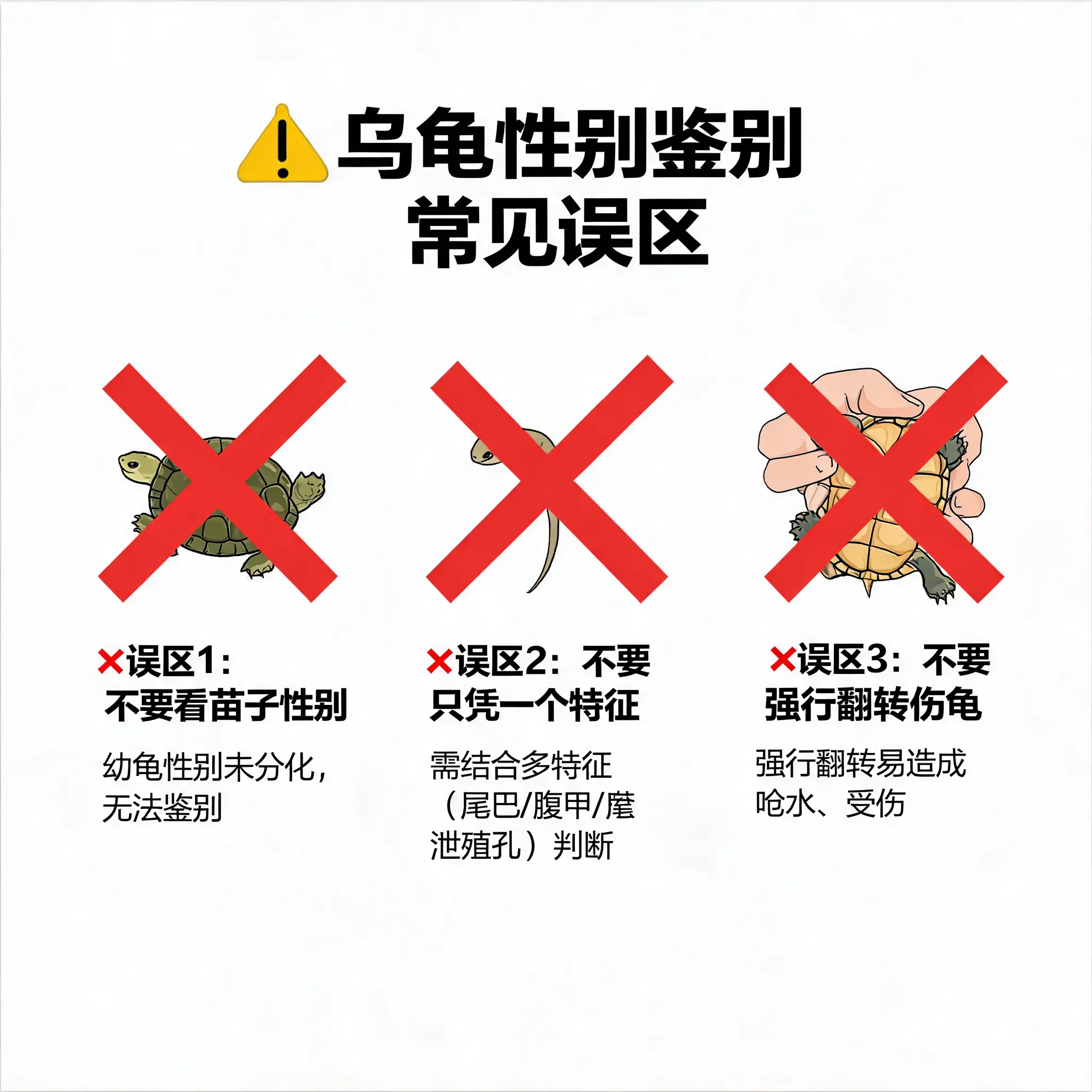
There are many common misconceptions in sex identification. Knowing them helps avoid mistakes.
Misconception 1: You Can Sex a Hatchling
Wrong! A hatchling's (carapace under 5 cm) secondary sex characteristics have not developed and males and females look almost identical. Anyone claiming to sex a hatchling is unreliable unless they can tell you the exact incubation temperature (which is nearly impossible). It is best to wait until the turtle reaches the identification-standard size.
Misconception 2: Judging by One Feature Only
Wrong! A single feature may show individual variation or error. For example, some males' plastron concavity is not obvious; some females' claws may also be long. It is best to combine at least 3 features to ensure accuracy.
Misconception 3: Using the Same Method for Different Species
Wrong! Different species have different sex features. Claws work well for red-eared sliders but not for Chinese pond turtles; melanism is an important feature for pond turtles but red-eared sliders do not have it. Know the traits of the species you keep and use the matching method.
Misconception 4: Force-Turning Harms the Turtle
Turn the turtle gently when observing the plastron to avoid frightening or injuring it. Return it to its normal position immediately after observing. Keeping it turned over for a long time affects its breathing and internal organs—never handle it roughly.
The Right Attitude
Sex identification takes patience and careful observation. If you are unsure, do not rush to a conclusion. You can wait for the turtle to keep growing or consult experienced keepers. Remember: sex is just one attribute of a turtle, and both males and females need the same careful care.