

Hibernation is a survival strategy turtles use to cope with low temperatures, surviving the winter food shortage by lowering their metabolic rate and reducing energy consumption. Turtle hibernation is fundamentally different from that of mammals—turtles are ectotherms whose body temperature follows the environment, so hibernation is a passive adaptation, not active regulation. Understanding the physiology of hibernation is the prerequisite for safe artificial hibernation.
Hibernation vs Torpor vs Brumation
The differences among the three low-temperature states:
Hibernation:
- Deep metabolic suppression, body temperature drops close to ambient
- Heart rate and breathing drop sharply (heart rate <5 beats/min)
- Slow response to external stimuli
- Duration: weeks to months
- Energy consumption: down to 5-10% of normal
Torpor:
- Shallow metabolic suppression, body temperature slightly above ambient
- Moderate drop in heart rate and breathing
- Still responds to external stimuli
- Duration: hours to days
- Energy consumption: down to 30-50% of normal
Brumation:
- A reptile-specific term, between hibernation and torpor
- A turtle's "hibernation" is actually closer to torpor
- Enters the dormant state when body temperature falls below 15°C
- Intermittent arousal; activity does not stop completely
Scientific note: a turtle's low-temperature state should be called "brumation," not "hibernation." But by convention it is still called hibernation.
The Evolutionary Significance of Turtle Hibernation
Hibernation is an evolved survival strategy for turtles:
Energy saving:
- Food is scarce in winter and turtles cannot obtain enough energy to stay active
- Hibernation minimizes energy consumption, and stored fat is enough to survive the winter
- A healthy turtle can survive 3-4 months without eating
Environmental adaptation:
- Turtles are ectotherms and cannot actively maintain body temperature
- Metabolic efficiency drops at low temperatures, so staying active is actually harmful
- Hibernation is the optimal passive adaptation to low temperatures
Reproductive regulation:
- Hibernation stimulates the reproductive system and promotes spring mating behavior
- After hibernation, testosterone rises in males and follicle development accelerates in females
- Turtles that do not hibernate may have reduced reproductive capacity
Geographic adaptation:
- Temperate species (red-eared slider, Chinese pond turtle) hibernate naturally
- Tropical species (tortoises, some aquatic turtles) do not hibernate
- Hibernation needs vary by species and cannot be generalized
Once a turtle enters hibernation, every system in its body changes markedly. These changes are orderly and gradual, regulated by both hormones and ambient temperature. Understanding these physiological changes is the basis for assessing a turtle's hibernation state and judging whether hibernation is safe.
Changes in Metabolic Rate
Metabolic rate decreases exponentially as temperature falls:
Metabolic rate formula:
Q = Q₀ × 2^(T/10)
Here Q₀ is the baseline metabolic rate and T is the temperature change.
Specific data:
- 25°C: normal metabolic rate (baseline)
- 15°C: metabolic rate drops to about 50%
- 10°C: metabolic rate drops to about 25%
- 5°C: metabolic rate drops to about 12.5%
- 0°C: metabolic rate drops to about 6%
Optimal hibernation temperature:
- 5-10°C: clear metabolic suppression, but basic life activities can still be maintained
- Below 5°C: frostbite and metabolic disorder may occur
- Above 10°C: metabolic consumption is too high and energy reserves are insufficient
Conclusion: the best artificial hibernation temperature is 5-10°C.
Cardiovascular Changes
The cardiovascular system of a hibernating turtle is markedly suppressed:
Heart rate changes:
- Normal state (25°C): heart rate 30-40 beats/min
- Entering hibernation (10°C): heart rate drops to 5-10 beats/min
- Deep hibernation (5°C): heart rate drops below 5 beats/min
- Heart rate has an approximately linear relationship with temperature
Blood pressure changes:
- Blood pressure drops about 50% during hibernation
- Blood circulation slows markedly
- Tissue oxygen supply decreases, but oxygen demand also drops sharply
Circulation adjustments:
- Blood is preferentially supplied to core organs such as the heart and brain
- Blood flow to peripheral tissues (limbs, skin) decreases
- A "core circulation" pattern forms
Blood composition changes:
- Red blood cell count increases (to compensate for reduced oxygen-carrying capacity)
- Blood glucose concentration rises (to maintain energy supply at low temperature)
- Blood viscosity increases (a low-temperature effect)
Respiratory Changes
The breathing rate of a hibernating turtle drops sharply:
Breathing rate changes:
- Normal state (25°C): 4-8 breaths/min
- Entering hibernation (10°C): drops to 1-2 breaths/min
- Deep hibernation (5°C): drops below 1 breath/min (intermittent breathing)
Breathing pattern changes:
- From continuous breathing to intermittent breathing
- Breathing may pause for several minutes
- Gas exchange relies mainly on the skin and throat
- Oxygen consumption drops to 10% of normal
Oxygen needs in the hibernation environment:
- A hibernating turtle's oxygen demand is extremely low
- But it cannot be completely deprived of oxygen (which causes death)
- The hibernation container must be breathable (do not seal it)
- Aquatic turtles hibernating in water need the surface in contact with air
Suffocation risk:
- An aquatic turtle hibernating in water may suffocate if it stays at the bottom too long
- Hibernation water depth should not exceed twice the height of the carapace
- Provide a shallow-water area for the turtle to raise its head and breathe
Digestive Changes
The digestive system of a hibernating turtle stops working entirely:
Gut state:
- Gastrointestinal peristalsis stops
- Digestive enzyme secretion stops
- Food residue stops being digested
- Gut contents may rot (so the gut must be cleared)
Why clearing the gut matters:
- The gut must be emptied before hibernation
- Gut contents in an uncleared turtle rot and produce toxins
- This can cause death during hibernation or infection after waking
- Method: stop feeding 2-3 weeks before hibernation and stimulate defecation with warm water
Liver changes:
- Liver glycogen is broken down into glucose for energy
- Liver fat is mobilized and converted into energy
- Liver volume may increase (fat accumulation)
After waking:
- The digestive system needs 1-2 weeks to recover
- Do not feed immediately in the first week
- Rehydrate first, then feed gradually
During hibernation a turtle relies on stored energy to stay alive. Understanding the mechanisms and patterns of energy metabolism makes it possible to assess whether a turtle is fit for safe hibernation and to predict its recovery after hibernation.
Forms of Energy Storage
Turtles store energy mainly in three forms:
Fat reserves (the main energy source):
- Storage sites: liver, abdominal fat bodies, subcutaneous fat
- Share of body weight: a healthy turtle should have 5-10% fat reserves
- Hibernation use: fat accounts for 80% of total energy consumption
- Each gram of fat provides about 9 kcal of energy
Glycogen reserves (a short-term energy source):
- Storage sites: liver, muscle
- Share of body weight: about 1-2%
- Hibernation use: glycogen accounts for 15% of total energy consumption
- Each gram of glycogen provides about 4 kcal of energy
Protein reserves (an emergency energy source):
- Storage site: muscle tissue
- Protein is not normally consumed
- Protein is mobilized only when fat runs out
- Protein consumption means the turtle is near death
Energy consumption calculation:
- A 500 g turtle hibernating 3 months at 10°C
- Energy consumed: about 500 g × 0.06 × 90 days × 0.5 kcal/g ≈ 1350 kcal
- Fat needed: about 1350 kcal ÷ 9 kcal/g ≈ 150 g
- Share of body weight: about 150 g ÷ 500 g = 30%
Conclusion: a turtle needs sufficient fat reserves to hibernate; thin turtles should not hibernate.
Energy Consumption During Hibernation
Energy consumption during hibernation is closely tied to temperature:
Energy consumption formula:
E = M × T × D
Here M is body weight, T is the temperature coefficient, and D is the number of days.
Temperature coefficient (consumption per gram of body weight per day):
- 5°C: about 0.03 kcal/g/day
- 10°C: about 0.06 kcal/g/day
- 15°C: about 0.12 kcal/g/day
Estimated hibernation consumption (500 g turtle, 3 months):
- Hibernating at 5°C: consumes about 45 g of fat
- Hibernating at 10°C: consumes about 90 g of fat
- Hibernating at 15°C: consumes about 180 g of fat
Conclusion: the higher the temperature, the greater the energy consumption. Hibernation temperature should not exceed 10°C.
Body weight monitoring:
- Safe hibernation: weight loss <15%
- Weight loss over 15% indicates insufficient energy reserves
- Weight loss over 20% carries a risk of death
- Weight should be checked regularly during hibernation
Energy Recovery After Waking
After waking, the turtle is in an energy-depleted state and needs to replenish quickly:
First week after waking:
- The turtle is weak with little appetite
- Focus on rehydration (electrolyte water)
- Do not feed immediately (the digestive system has not recovered)
- Warm-water soaking promotes metabolic recovery
Second week after waking:
- The digestive system gradually recovers
- Start feeding small amounts (easily digestible food)
- Feed about 50% of normal
- Continue rehydrating
Third week after waking:
- The digestive system has basically recovered
- Feed normally
- Appetite returns to normal
- Provide high-protein, high-calcium food
Recovery-period nutrition advice:
- Week 1: electrolyte water, glucose water
- Week 2: small fish and shrimp, quality turtle food
- Week 3: normal diet, plus calcium powder
Notes:
- Feeding immediately after waking may cause indigestion
- Overfeeding may cause gastroenteritis
- During recovery the turtle's resistance is weak; watch for infection

The onset and end of turtle hibernation are regulated by hormones. Understanding the hormonal mechanisms helps judge whether a turtle is ready to hibernate and what behavioral changes may appear after waking.
Hibernation Onset Signals
Hibernation onset is regulated jointly by temperature and photoperiod:
Temperature signals:
- When the ambient temperature stays below 15°C, the turtle begins preparing for dormancy
- When body temperature drops below 10°C, the turtle formally enters hibernation
- The speed of temperature decline affects hibernation onset (a sharp drop may cause stress)
Photoperiod signals:
- Shorter autumn daylight triggers hormonal changes
- The pineal gland senses the photoperiod change
- Regulates melatonin secretion
Hormonal changes:
- Melatonin increases: suppresses appetite and promotes dormancy
- Thyroid hormones (T3/T4) decrease: lower the metabolic rate
- Cortisol adjusts: regulates the stress response
Preparatory behavior:
- Reduced appetite and less eating
- Reduced activity and more hiding
- Seeking a safe hibernation spot
- Slower breathing rate
Preparing for artificial hibernation:
- Gradually lower the water temperature in autumn (2-3°C per week)
- Reduce the amount of food
- Shorten the lighting period
- Mimic the natural cooling process
Maintenance Mechanism
Hormones remain at low levels during hibernation:
Hormone status:
- Thyroid hormones: extremely low (metabolic suppression)
- Melatonin: continuously high (maintains dormancy)
- Testosterone/estrogen: low (reproductive suppression)
- Cortisol: low (stress suppression)
Metabolic regulation:
- Low thyroid hormones maintain a low metabolic rate
- Melatonin suppresses the appetite center
- The overall hormonal environment maintains the dormant state
Intermittent arousal mechanism:
- A hibernating turtle may arouse intermittently (when temperature fluctuates)
- Arousal consumes a lot of energy (the metabolic cost of recovery is high)
- Frequent arousal accelerates energy depletion
- Artificial hibernation should keep the temperature stable
Why temperature stability matters:
- Temperature fluctuation triggers arousal
- Arousal consumes about 10 times the energy of the dormant state
- Each arousal may consume 1-2 days of energy reserves
- Hibernation temperature should be stable at 5-10°C
Hibernation End Signals
Rising spring temperatures trigger the end of hibernation:
Temperature signals:
- An ambient temperature persistently above 15°C triggers arousal
- The speed of temperature rise affects the speed of arousal
- A sharp rise may cause stress ("shock")
Photoperiod signals:
- Spring daylight lengthens
- The pineal gland senses the photoperiod change
- Melatonin secretion decreases
Hormonal changes:
- Melatonin decreases: releases the dormancy suppression
- Thyroid hormones increase: restore the metabolic rate
- Testosterone/estrogen increase: activate the reproductive system
- Cortisol increases: cope with arousal stress
Arousal process:
- Stage 1: heart rate and breathing begin to speed up
- Stage 2: the limbs begin to move
- Stage 3: fully awake and begins foraging
Arousal time:
- Natural arousal takes 1-2 days
- Artificial warming arousal takes 2-4 hours (should not be too fast)
- A daily rise of 2-3°C is appropriate
Notes:
- After waking the turtle is weak and prone to infection
- It needs a quiet recovery environment
- Resume normal feeding after the temperature returns to 25°C
Artificial hibernation carries risks and must meet safety conditions. Forcing a turtle that does not meet the conditions to hibernate may cause death. Assessing the turtle's health and hibernation readiness is the key to safe hibernation.
Analysis of Hibernation Death Causes
The main causes of turtle death during hibernation:
Energy depletion:
- Insufficient fat reserves to get through hibernation
- Hibernation temperature too high, so energy is consumed too fast
- Weight loss over 20%
- Accounts for 40% of hibernation deaths
Gut infection:
- The gut was not cleared before hibernation and its contents rot
- Rotting produces toxins, causing septicemia
- Bacterial infection spreads throughout the body
- Accounts for 25% of hibernation deaths
Frostbite:
- Hibernation temperature below 0°C
- Ice crystals form inside cells, damaging tissue
- Organ failure
- Accounts for 15% of hibernation deaths
Suffocation:
- An aquatic turtle hibernating in water stays at the bottom too long and cannot breathe
- The hibernation container is sealed and lacks oxygen
- Accounts for 10% of hibernation deaths
Disease:
- Pre-existing disease before hibernation (pneumonia, skin rot, etc.)
- Disease worsens during hibernation
- The turtle cannot fight off the infection
- Accounts for 10% of hibernation deaths
Prevention points: ensure fat reserves, clear the gut, control the temperature, provide oxygen, and do a pre-hibernation health check.
Safe Hibernation Conditions
A turtle must meet the following conditions to hibernate safely:
Age conditions:
- Hatchlings (<1 year): not advised to hibernate; insufficient energy reserves
- Sub-adults (1-3 years): may attempt a short hibernation (1-2 months)
- Adults (>3 years): may hibernate normally (3-4 months)
- Advice: hatchlings have a high hibernation mortality rate and are not recommended
Health conditions:
- Strong and free of obvious disease
- Turtles with diarrhea, pneumonia, or skin rot should not hibernate
- No recent medication history (medication may affect hibernation)
- Bright eyes and normal activity
Weight conditions:
- Weight loss within the normal range
- The base of the legs feels springy when pinched (fat reserves)
- The shell is full with no sunken areas
- Weight within the normal range for turtles of the same age
Gut-clearing conditions:
- Stop feeding 2-3 weeks before hibernation
- Soak in warm water to stimulate defecation
- Confirm the gut is completely empty
- Note the time of the last defecation
Species conditions:
- Temperate species (red-eared slider, Chinese pond turtle): may hibernate
- Tropical species (some tortoises): do not hibernate
- Hybrid species: confirm the species' habits
Conclusion: hatchlings, sick turtles, thin turtles, and tropical species are not advised to hibernate.
Pre-Hibernation Health-Check List
A complete health check must be done before hibernation:
Appearance check:
- The shell is intact with no damage
- No signs of skin rot (red, swollen, or ulcerated skin)
- Bright eyes with no white eye disease
- Normal limb movement
- No trauma
Weight check:
- Record the weight as a baseline
- Compare with the normal weight range
- Confirm sufficient fat reserves
- An underweight turtle should not hibernate
Activity check:
- Normal swimming posture
- Normal crawling ability
- Quick responses
- Normal appetite
Gut-clearing check:
- Check defecation after 2-3 weeks of fasting
- Soak in warm water to stimulate defecation
- Observe the color and consistency of the droppings
- Confirm the gut is empty
Blood test (optional):
- Blood glucose level (normal range)
- White blood cell count (no infection)
- Blood calcium level (skeletal health)
Interpreting the results:
- All normal: may hibernate
- Abnormalities present: treat first, then decide after recovery
- Severe abnormalities: give up hibernation and keep the turtle warm through the winter
There are three main methods of artificial hibernation: shallow-water hibernation, mud-and-sand hibernation, and refrigerator hibernation. Each has pros and cons, and choosing the method suited to your conditions is the key to successful hibernation.
Shallow-Water Hibernation
Shallow-water hibernation is the simplest method and suits beginners:
Preparation:
- Prepare a spacious container (a plastic box or shallow tank)
- Water about 5-10 cm deep (slightly above the carapace)
- Use dechlorinated water
- Place the container in a cool spot (5-10°C)
The hibernation process:
- Place the turtle in the shallow water
- The turtle naturally enters hibernation
- The turtle may stay at the bottom or raise its head above the surface
- Check its condition once a week
Pros:
- Simple to operate
- Plenty of water (the turtle will not dehydrate)
- Easy to observe its condition
- Suited to aquatic turtles
Cons:
- Water quality may deteriorate (regular water changes needed)
- Water temperature fluctuates more
- The turtle may stay at the bottom too long and lack oxygen
Notes:
- Provide a shallow-water area for the turtle to raise its head and breathe
- Water depth no more than twice the height of the carapace
- Change a small amount of water during hibernation (once a month)
- Check whether the turtle is abnormally floating
Mud-and-Sand Hibernation
Mud-and-sand hibernation mimics the natural environment and suits those with some experience:
Preparation:
- Prepare a large container
- Spread moist mud and sand on the bottom (10-15 cm thick)
- Sand moisture about 60% (holds shape when squeezed, crumbles when released)
- The mud and sand must be free of harmful substances (dedicated mud/sand or river sand)
The hibernation process:
- Place the turtle on the mud and sand
- The turtle burrows into it on its own
- The mud and sand cover most of its body
- The turtle hibernates in the mud and sand
Pros:
- Mimics the natural environment
- The turtle feels safer (burrowing instinct)
- More stable temperature
- Not prone to dehydration
Cons:
- Hard to observe (the turtle is buried)
- Checking requires digging
- The mud and sand may grow bacteria
- More complex to operate
Notes:
- Keep the mud and sand moist but not waterlogged
- Check the moisture regularly
- Dig gently when checking the turtle's condition
- Keep the hibernation container at 5-10°C
Refrigerator Hibernation
Refrigerator hibernation provides the most stable temperature and suits experienced keepers:
Preparation:
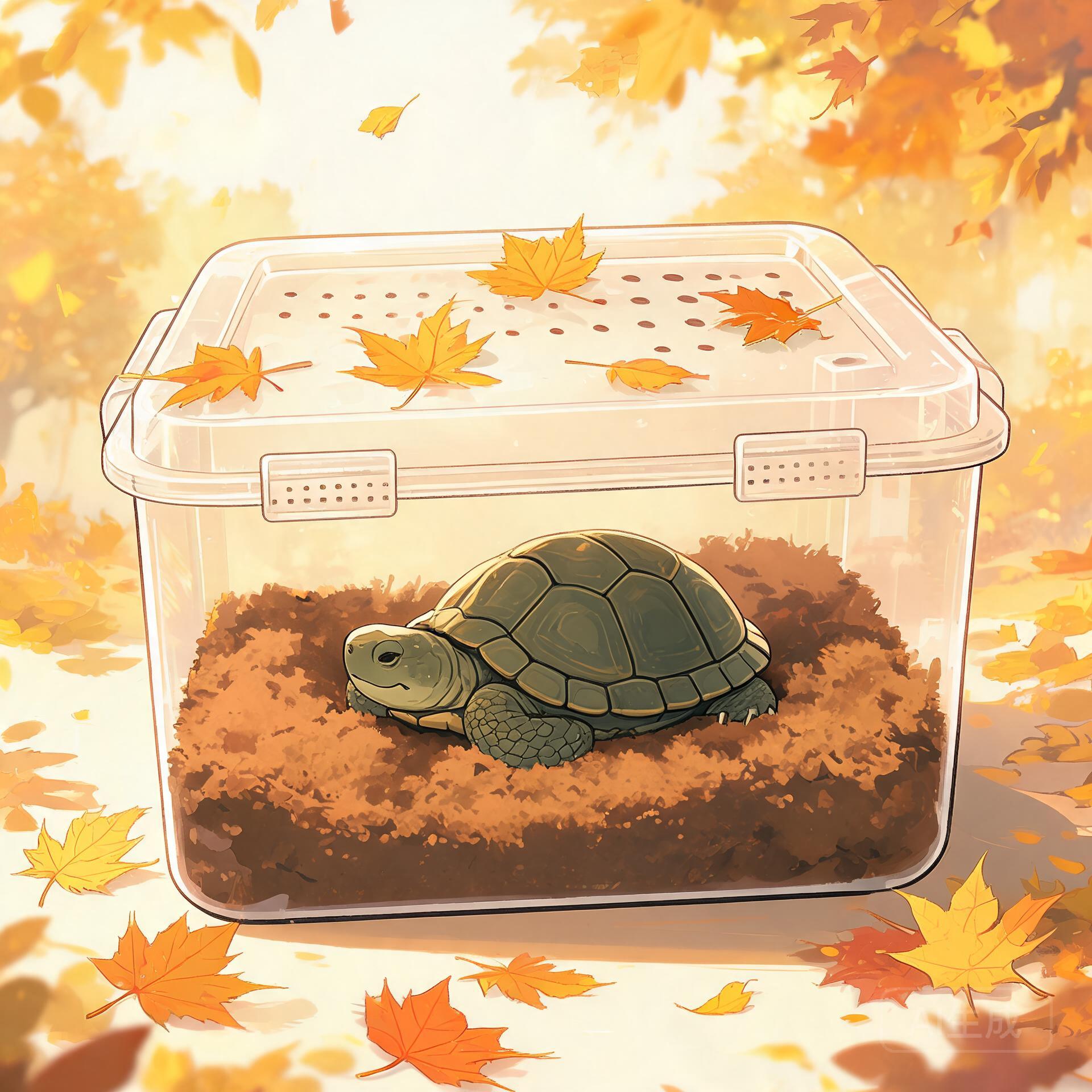
- Prepare a breathable container (a plastic box with holes)
- Place a moist towel or shallow water inside
- Put the container in the refrigerator's cool compartment (5-10°C)
- Do not put it in the freezer
The hibernation process:
- Place the turtle in the container
- Put the container in the refrigerator
- The turtle hibernates at a stable low temperature
- Check its condition once a week
Pros:
- The most stable temperature (around 5°C)
- Lowest energy consumption
- Unaffected by outside temperature swings
- Easy to control the hibernation period
Cons:
- Requires a dedicated refrigerator (cannot share with food)
- Limited space
- Temperature changes when taken out for checking may cause stress
- The turtle may dehydrate
Notes:
- The container must be breathable (do not seal it)
- Set the refrigerator temperature to 5-10°C
- Do not take it out to check too often
- Keep the inside of the container moist
- Use a dedicated refrigerator or a separate compartment
During hibernation the turtle's condition should be monitored regularly, and after waking it needs careful care. These two stages are the keys to a successful hibernation.
Monitoring During Hibernation
Frequency and method of hibernation monitoring:
Monitoring frequency:
- Check the condition once a week
- Measure the weight once a month
- Increase the frequency when the temperature changes
What to monitor:
- Temperature: confirm it stays stable at 5-10°C
- Weight: record weight loss; intervene if over 15%
- Activity: check for abnormal arousal
- Appearance: check for skin rot, white eye, and other symptoms
Normal state:
- The turtle is quiet and motionless
- Breathing is extremely slow (<1 breath/min)
- Limbs are drawn into the shell
- Weight drops slowly (<5%/month)
Abnormal state:
- The turtle is frequently active (temperature too high)
- Weight drops quickly (>10%/month)
- Body odor (infection)
- Swollen eyes (white eye disease)
Interventions:
- Weight dropping too fast: end hibernation early
- Infection found: end hibernation immediately and treat
- Temperature too high: adjust the hibernation environment
- Abnormal arousal: check the environment for problems
Care After Waking
The proper care process after hibernation:
Arousal stage (days 1-2):
- Move the turtle out of the hibernation container
- Soak it in shallow warm water (25°C)
- Do not feed immediately
- Let the turtle naturally resume activity
Recovery stage (days 3-7):
- Gradually return the temperature to the normal housing temperature (28-30°C)
- Soak in warm water daily to promote metabolism
- Provide clean water for drinking
- Feed little or not at all
Normal housing stage (after day 8):
- Resume normal feeding
- Gradually increase the amount
- Provide high-protein food
- Supplement with calcium powder
Common problems after waking:
Weakness:
- Normal; recovers in 1-2 weeks
- Provide electrolyte water
- Avoid stress
Food refusal:
- The digestive system has not recovered; wait patiently
- Warm-water soaking stimulates appetite
- Try strongly enticing food (shrimp)
Infection:
- Resistance is weak after hibernation and infection is easy
- Pay attention to water cleanliness
- Treat infections promptly when found
Post-waking health check:
- Check weight recovery
- Check the shell, limbs, and eyes
- Observe activity ability
- Deal with anything abnormal promptly
Record-Keeping and Experience Building
Keep detailed records for every hibernation:
Record contents:
- The turtle's age, weight, and health
- Hibernation start date
- Hibernation method (water/mud-and-sand/refrigerator)
- Hibernation temperature changes
- Weight and condition at each check
- Hibernation end date
- Recovery after waking
Record template:
Turtle ID: red-eared slider A001
Age: 3 years
Weight: 500 g before hibernation, 450 g after (a 10% drop)
Hibernation method: shallow-water hibernation
Hibernation temperature: 5-8°C
Hibernation period: 2025-11-15 to 2026-03-15 (4 months)
Check records:
- Month 1: weight 480 g, normal
- Month 2: weight 465 g, normal
- Month 3: weight 450 g, normal
- Month 4: awake, recovering well
Recovery after waking: normal feeding began on day 8
Building experience:
- Successful hibernation: summarize the success factors
- Failed hibernation: analyze the failure causes
- Compare the pros and cons of different methods
- Improve hibernation technique year by year
Improving the hibernation success rate:
- First hibernation: a short hibernation (1-2 months) is advised
- After gaining experience: extend the hibernation time
- Record every year and optimize year by year
- Do not blindly pursue long hibernation